Rail project · 140km · Planned for 2035

A train in Reunion Island? The 140km Reunion Express rail project, due in 2035

Reunion Island has had no trains since the 1970s. That could change: the plan is for 140 kilometres of track between Saint-Benoît and Saint-Joseph, costing €3 billion, with a train every 15 minutes at 110km/h. Here's what was agreed on 29 August 2025, the 3-phase timeline, what's at stake and what's still undecided.

140km of track€3bn investment15 min between trains
At a glance

The Reunion Express project in 8 key facts

Total length
140km, Saint-Benoît to Saint-Joseph
Total investment
€3 billion
Top speed
110km/h
Target frequency
A train every 15 min
Construction starts
2030
Planned opening
2035
Roadmap signed
29 August 2025
Public support
3 out of 4 Reunion Islanders (2023 forums)
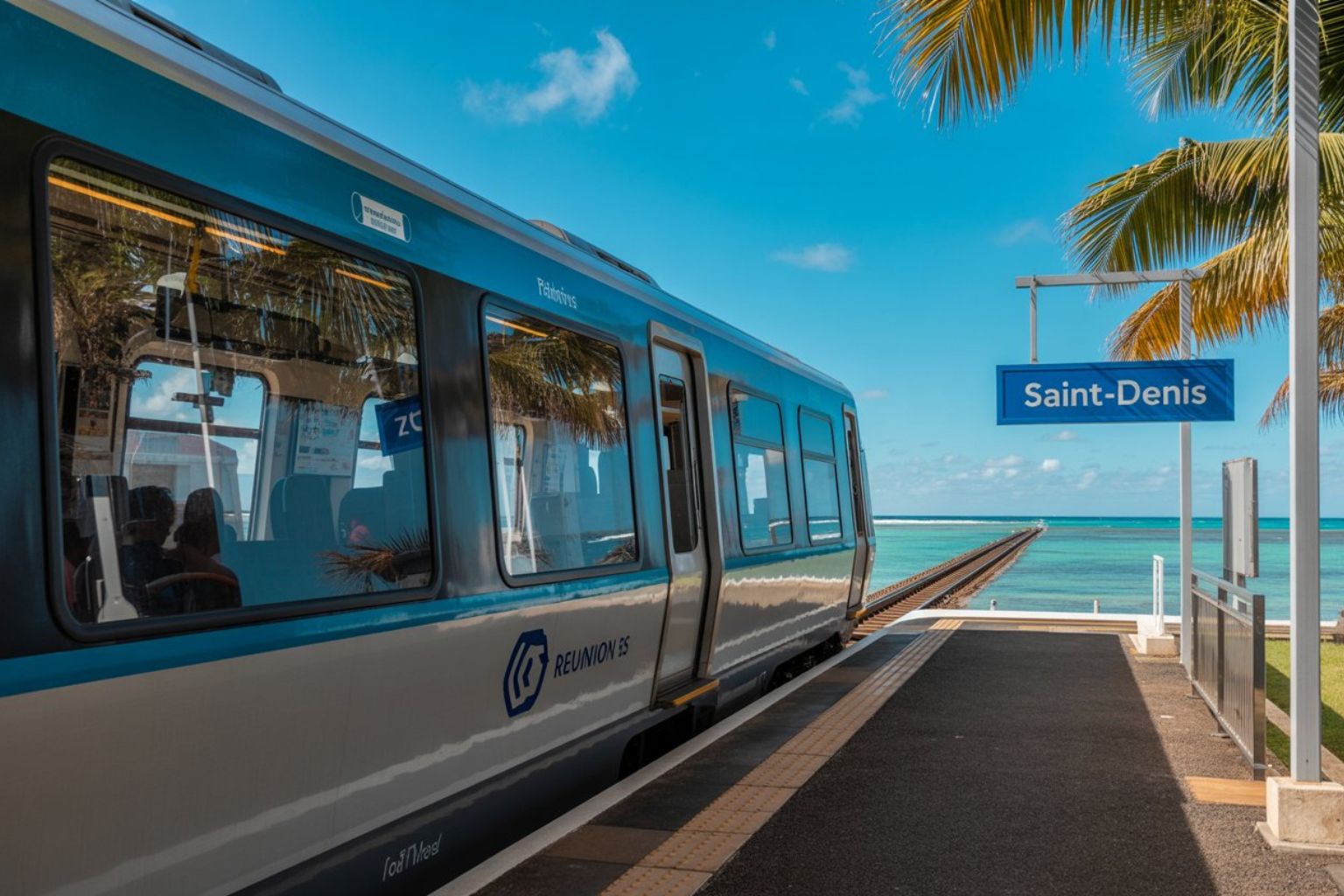
A note on the visuals: the images on this page are illustrations (AI renderings of a typical commuter train at a Reunion Island station). The final route, trains and station designs haven't been decided and will be confirmed after the 2026-2027 public inquiry.

On 29 August 2025, every group of local councils in Reunion Island, the Region and the French State signed a joint roadmap confirming the Reunion Express Train, a planned 140-kilometre railway between Saint-Benoît and Saint-Joseph. The timeline allows for a 2-year public inquiry (2026-2027), detailed studies (2027-2030), construction from 2030 and an opening in 2035. This page sums up what's known so far and what's still undecided.

3 phases

Three phases, one after the other

Phase 1: the main corridor from Saint-Benoît to Saint-Paul (~75km). Phase 2: L'Étang-Salé to Saint-Pierre (~20km). Phase 3: the link from Saint-Paul to L'Étang-Salé via Saint-Leu (~45km). Construction is planned over 5 years, with sections opening in stages.

Phase 1

Phase 1, the north-west line from Saint-Benoît to Saint-Paul

Length: About 75kmSection: Saint-Benoît, Saint-André, Sainte-Suzanne, Sainte-Marie, Saint-Denis, La Possession, Le Port, Saint-PaulWho it serves: 8 towns served, a catchment area of 700,000 people

The first phase covers the island's busiest corridor, from the east (Saint-Benoît) to the west (Saint-Paul) via the north coast and the capital, Saint-Denis. This stretch is home to nearly 80% of the working population of the north and west, and the RN1 and RN2 main roads are jammed every day. The exact route hasn't been decided (a public inquiry is under way), with two main options: a coastal route along the main road, shorter and more visible, or a partly underground route through the hills to limit the impact on built-up areas.

Phase 2

Phase 2, the south line from L'Étang-Salé to Saint-Pierre

Length: About 20kmSection: L'Étang-Salé, Saint-Louis, Saint-PierreWho it serves: 3 towns, a catchment area of 100,000 people

The second phase links the southern end of the western line (L'Étang-Salé) with Saint-Pierre, the island's second-largest town. It's shorter and easier to build on less constrained land, and completes the coverage of the island's main population centres. These towns account for a large share of the south's industry and services, and the RN1 between Saint-Louis and Saint-Pierre has been a notorious traffic black spot for 15 years.

Phase 3

Phase 3, the link from Saint-Paul to L'Étang-Salé via Saint-Leu

Length: About 45kmSection: Saint-Paul, Trois-Bassins, Saint-Leu, L'Étang-SaléWho it serves: 4 towns, the west coast tourist corridor

This final phase completes the Saint-Benoît to Saint-Joseph line by joining phase 1 (ending at Saint-Paul) to phase 2 (starting at Saint-Joseph) via Saint-Leu. It runs along the touristy west coast, with stops expected to serve the beach resorts of L'Hermitage, La Saline-les-Bains and Saint-Leu. It's technically harder (steep ground, ravines to cross, sensitive land in tourist areas), which is why it comes last.

4 expected benefits

Why everyone from the State to the local councils backs it

Reunion Island squeezes 870,000 people onto a narrow coastal strip, and its reliance on the car is among the highest of any French department. In the 2023 public consultations, 3 out of 4 locals backed the idea of an express train. Here are the 4 main benefits expected.

Easing traffic on gridlocked roads

The RN1 and RN2, the island's main roads, carry an average of 100,000 vehicles a day on their busiest stretches, peaking at 130,000. At morning and evening rush hour, journey times double or triple. A frequent express train would offer a real alternative and take pressure off the roads without laying any new tarmac.

Cutting the carbon cost of travel

Transport currently accounts for more than 50% of Reunion Island's greenhouse gas emissions, 70% of it from private road vehicles. An electric railway, running on the island's changing energy mix (the target is 100% renewable by 2030), would cut emissions per passenger-kilometre sharply compared with petrol or diesel cars.

Linking up the main job centres

Several job centres (the Le Port industrial zone, government offices in Saint-Denis, services in Saint-Pierre, tourism in Saint-Paul) are hard to reach for anyone who doesn't live nearby, as there's no real alternative to the car. A train every 15 minutes would link them up and make commutes of 30 to 80 kilometres much easier.

Reshaping towns around the stations

A new railway usually brings development around its stations (housing, shops, park-and-ride car parks, connecting bus routes). It's an often-overlooked effect of rail: it shapes property and business development for decades. The towns concerned are already factoring this into their local planning.

Open questions

6 questions still to be answered

The project itself is agreed, but several technical and political questions still need answering during the 2-year public inquiry (2026-2027) and the 3 years of detailed studies (2027-2030). This page will be updated as announcements are made, so don't treat the precise figures as final.

Is the €3 billion funding secured?

The roadmap signed on 29 August 2025 by every group of local councils, the Region and the French State confirms the project and its overall budget, but not yet the detailed funding plan. The money is expected to come from the French State (multi-year agreements), the Reunion Island Region (its own funds and borrowing), the European Union (ERDF funds for the EU's outermost regions) and possibly a public-private partnership to run the line. The details will be settled after the public inquiry.

Why 2035 and not sooner?

The timeline allows 2 years for the legally required public inquiry (until the end of 2027), 2-3 years of detailed studies and engineering (2027-2030), then 5 years of construction (2030-2035). That's in line with, or even a little tight for, rail projects of this size in France. A delay of 12-24 months at any stage would push the opening back to 2036-2037.

Will land have to be compulsorily purchased?

The route hasn't been decided yet, but the coastal option would cross built-up areas (Saint-André, Sainte-Suzanne, Sainte-Marie), with a risk of some compulsory purchases. The partly underground option through the hills would limit that, but cost more. The 2-year public inquiry will give affected owners their say and allow the route to be adjusted.

Didn't Reunion Island once have a railway?

Yes. From 1882 to 1976, the CFR (Chemins de fer de La Réunion) linked Saint-Pierre to Saint-Benoît via Saint-Denis over about 130 kilometres. It was dismantled in the 1970s when the island switched to roads, but traces remain (the Bras de la Plaine bridge, tunnels on the north coast). The new project doesn't follow the old route, but it marks a return to rail after 60 years without trains.

What happens to the buses (Car Jaune, Citalis)?

The train isn't meant to replace the buses (Car Jaune between towns, Citalis in Saint-Denis) but to work alongside them. It would provide fast, frequent links on the main corridors, while buses would keep serving smaller towns and the stops in between. The bus network is expected to be redesigned to feed into the new stations.

Will it help visitors?

A little. The Express train is first and foremost for locals' everyday journeys, not a tourist attraction. That said, visitors will be able to use it to reach the main coastal towns from Roland Garros airport (Sainte-Marie) without hiring a car for town-to-town trips. For the highlands (Cilaos, Salazie, Maïdo, the volcano), you'll still need a car, as there are no plans to take the line into the cirques or mountains.

An illustrative projection: a train at a tropical station lined with coconut trees, facing the lagoon, the future Reunion Island line
Until 2035

Until the train arrives, you'll need a car

Until at least 2034, getting around Reunion Island means a car or the buses (Car Jaune between towns, Citalis in Saint-Denis and various local networks). If you're visiting for a short trip, budget for a hire car, especially for the highlands, the cirques and the hiking trails, which the train won't reach even after 2035.

For longer stays (1-3 months), a long-term rental from a local firm works out cheaper than standard car hire: around €600-900 a month for a small car, versus €30-50 a day for standard hire, the equivalent of €900-1,500 a month.

An illustrative projection: a modern train at Saint-Denis station facing the lagoon, the Reunion Express Train project for 2035
FAQ

Reunion Express Train: your questions answered

12 questions about the timeline, route, funding and impact, the old CFR railway, and what it all means for visitors.

When will the Reunion Express train open?+

The opening is planned for 2035, after a 2-year public inquiry and 5 years of construction (2030-2035). The official roadmap was signed by every group of local councils, the Region and the French State on 29 August 2025. Any delay to the public inquiry or technical studies could push the opening back to 2036-2037.

How long will the line be?+

140 kilometres in total, from Saint-Benoît in the north-east to Saint-Joseph in the south, via Saint-Denis, La Possession, Le Port, Saint-Paul, L'Étang-Salé and Saint-Pierre. It covers the whole north and west coast plus part of the south, but not the highlands or the cirques of Cilaos, Mafate and Salazie.

How much will it cost, and who's paying?+

The total cost is estimated at €3 billion. The funding plan isn't final yet, but the money is expected to come from the French State (multi-year agreements), the Reunion Island Region (its own funds and borrowing), the European Union (ERDF funds for its outermost regions) and possibly a public-private partnership to run the line. The details will be settled after the public inquiry.

How often will trains run?+

Every 15 minutes on the busiest sections, at up to 110km/h. That's frequent enough for commuters to turn up and go without checking a timetable, like the RER commuter trains around Paris. The quieter ends of the line (east and south) may have slightly fewer trains, to be decided in later studies.

Will the train replace the car in Reunion Island?+

No, it's meant to offer a real alternative on the main corridors, not to replace the car. For the highlands (Cilaos, Mafate, Salazie, Maïdo, the volcano), hiking trails and beaches far from the stations, you'll still need a car. Early estimates suggest the train could carry 15-25% of daily coastal journeys by 2040.

Do locals support the project?+

Yes, by a large majority. Public consultations on transport held by the Region in 2023 found that 3 out of 4 Reunion Islanders back the idea of an express train. The remaining objections are mostly about the route (compulsory purchases, impact on the landscape) and the cost (€3 billion, set against other social and economic priorities).

Is the exact route known?+

Not yet. Two main options are being studied: a coastal route along the RN1 and RN2, shorter and more visible but involving compulsory purchases, or a partly underground route through the hills, easier on built-up areas but more expensive to build. The 2-year public inquiry, starting in autumn 2025, will give residents their say and allow the route to be adjusted.

Will the train serve Roland Garros airport?+

Yes, an airport station is planned at Sainte-Marie in phase 1, so arriving travellers could reach Saint-Denis (10 minutes), Saint-Paul (35 minutes) or Saint-Pierre (1h30) without hiring a car. For the highlands (Cilaos, Salazie, Maïdo, the volcano), you'll still need a car from the airport.

What's the environmental impact?+

Positive overall, as long as the island's electricity is low-carbon. Reunion Island is aiming for 100% renewable electricity by 2030, which would make the Express train very low-carbon. It would take up less land than widening the roads by the same amount, and any crossings of sensitive natural areas are to be kept to a minimum during the public inquiry. Its carbon footprint is far better than that of petrol or diesel cars.

Has Reunion Island had a train before?+

Yes. From 1882 to 1976, the Chemin de fer de La Réunion (CFR) linked Saint-Pierre to Saint-Benoît via Saint-Denis over about 130 kilometres. It was dismantled in the 1970s when the island switched to roads, but you can still see traces of it (the Bras de la Plaine bridge, coastal tunnels from Pointe au Sel to Saint-Denis). The new project doesn't follow the old route.

Will the project create jobs?+

Yes. The study and construction phase (2027-2035) should create several thousand direct and indirect jobs (construction, civil engineering, signalling, electrification). Once the line opens (from 2035), there'll be several hundred permanent jobs for drivers, ticket inspectors, maintenance teams, station staff and security. The exact figures will come from economic impact studies.

Can you visit Reunion Island without a car?+

Not really, not yet. For now, a car is essential for getting around Reunion Island, especially to the highlands, the cirques, hiking trails and beaches away from the towns. 2035 is still a long way off, and even then the train won't end the island's reliance on roads. If you're visiting for 1-2 weeks, plan on hiring a car.

You're on Sous Les Étoiles 974

An independent guide to planning your trip to Reunion Island. Until the Reunion Express Train opens in 2035, you'll need a car for the highlands and hiking trails. Explore my guides to activities, places to stay and island news to plan your trip.

Page last updated: 30 October 2026. The figures and timeline on this page reflect information publicly available in 2026 and will be confirmed after the public inquiry.