Practical FAQ · Identity and symbols

Flag of Reunion Island: no official one, four versions in circulation

Reunion Island has no official regional flag. The French flag remains the only institutional emblem. Four designs are used in everyday life and at rallies, from the consensus-building Mavéli to the more radical pro-independence flag.

4 flags unofficial1 official (French tricolour)Mavéli 1975, the most used
Updated October 2026
The key thing to know

Reunion Island is a French department and has no official regional flag. The flags you see in everyday life are cultural or activist emblems, never institutional ones. For the detailed administrative status, see the DROM, ROM, COM, TOM guide.

You're on Sous Les Étoiles 974

The independent guide to planning your trip to Reunion Island

Beyond questions of identity and symbols, this site brings together more than 470 partner activities (helicopter, paragliding, hiking, whale-watching cruises, airport transfers...), a catalogue of hotels and gîtes across the island's 24 municipalities, and dozens of practical guides. An independent site run by someone passionate about Reunion Island.

Institutionally, the flag that officially flies over Reunion Island is the French tricolour. No regional flag has been formally adopted by either the Regional Council or the Departmental Council. Like Martinique, Guadeloupe and French Guiana, the island has remained an overseas department since the law of 19 March 1946 and flies the national flag.

In everyday life, however, four designs are flown as unofficial flags. The best known is the Mavéli, also called the Radiant Volcano, created in 1975 by physicist Guy Pignolet. Three others exist: the MLK flag (Creole-culture, 1984), the LPLP flag (pro-independence, 1986), and the APDR flag (1996, rarely seen).

A public consultation held in 2014 had placed the Mavéli far ahead of the other options, but the Regional Council never turned that result into an official deliberation. The topic remains sensitive because some flags carry activist overtones (particularly the pro-independence LPLP), which prevents any consensus.

The rest of this page presents the four flagsin detail, their origins, their creators, their symbols, as well as the island's other identity symbols (maloya, séga, the coq péï, Piton de la Fournaise).

Four flags in circulation

Mavéli, MLK, LPLP, APDR: a comparison

Four designs, four histories, four audiences. Here are the origins and symbols of each flag, with images to help you recognise them.

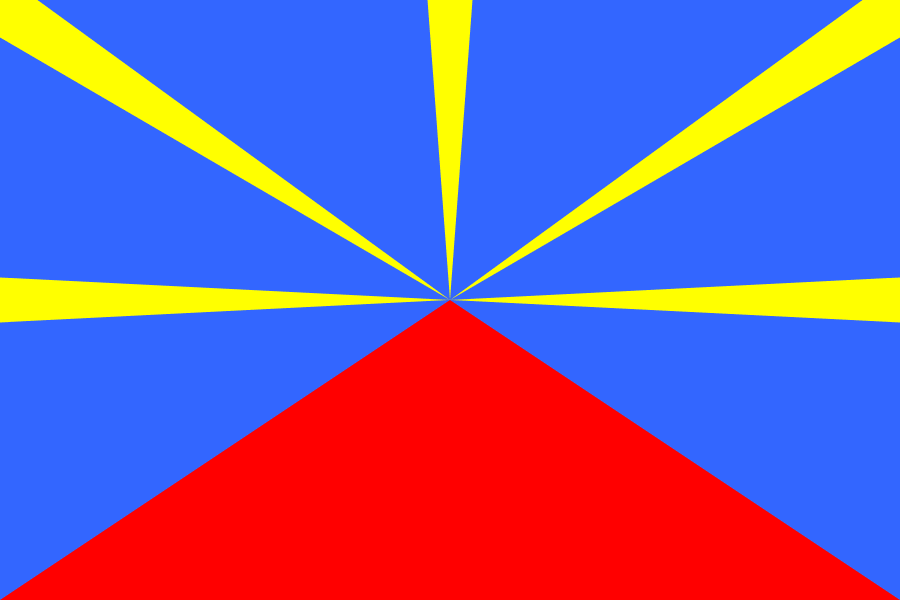
A graphic depiction of the Mavéli flag: a navy blue background, ten yellow rays emerging from a central point, a red triangle at the bottom pointing upward

Mavéli

“Radiant Volcano”
1975
Created by: Guy Pignolet (a physicist, authorship disputed by some activists)

A widely shared cultural emblem. Used at sporting and cultural events, with no political overtones.

The most widely accepted across all viewpoints. Chosen by the 2014 public consultation, though never officially adopted by the Regional Council.

Symbols
Blue: The sky and the Indian Ocean
Red triangle: Piton de la Fournaise, the island's volcanic power
Yellow rays: The sun and the island's diverse populations converging into a single people
The Mouvman Lantant Koudmin flag: a blue band at the top, green in the centre, black at the bottom, a red triangle on the left and a yellow sun disc

Drapo MLK

“Drapo kiltirel Larényon”
1984
Created by: François Saint-Omer for the Mouvman Lantant Koudmin association

A cultural flag claimed by advocates of the Creole language and the memory of slavery. Used during the 20 December commemorations (Fèt Kaf).

Creole-culture movements, maloya schools, historic-neighbourhood associations.

Symbols
Blue: The Indian Ocean
Green: Nature, hope, freedom
Black: The dark period of slavery
Red triangle: Piton de la Fournaise
Yellow circle: The island's sun
The pro-independence LPLP flag: three horizontal stripes, red, yellow and green, with a five-pointed yellow star in the upper left canton

Drapo LPLP

“The independence flag”
1986
Created by: Lorganizasyon Popilèr Po Libèr Nout Peï

A protest flag for pro-independence movements. Adopted in 2008 by some regionalist activists as the drapo nasion (national flag).

Minority political circles in favour of autonomy or independence from France. Seen at political demonstrations.

Symbols
Green: Freedom and the memory of marronage (escaped slaves who fled to the Hauts)
Yellow: The ancestral builders
Red: The suffering endured during the era of slavery
Five-pointed star: The 5 historic populations: Yab, Zarab, Malbar, Sinwa, Kaf
The APDR flag: the vertical French tricolour on the left, then four coloured triangles (orange, red, green, blue) radiating around a central white circle

Drapeau APDR

“Association for the Flag of Reunion Island”
1996
Created by: The APDR association (Saint-Denis)

An attempted compromise flag that explicitly incorporates the French tricolour on the left, signalling attachment to the Republic.

Rarely seen in practice. Remains a niche project championed by the association that created it.

Symbols
French tricolour (left): Attachment to the French Republic
Blue (left): Europeans and the ocean
Green (bottom): Africans and nature
Orange (top): Indians and the sun
Red (right): The Chinese community and the volcano
White circle (centre): Peace and harmony between communities
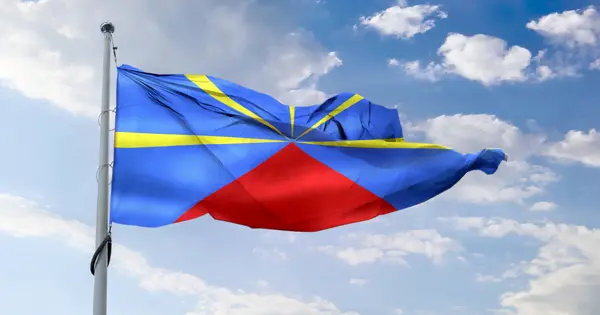
The Mavéli or Radiant Volcano flag of Reunion Island flying against a blue sky: a blue field, a fan of yellow rays, and a red triangle symbolising Piton de la Fournaise
The Mavéli

Radiant Volcano, the most widely flown flag on the island

Focus on the Mavéli

Why the Radiant Volcano is so widely accepted

The Mavéli was born in 1975from a design by Guy Pignolet, a physicist based in Reunion Island. The creator registered the design and then publicly waived any commercial rights to it, which allowed it to spread freely and widely. The design's success comes from how instantly readable it is: a stylised Piton de la Fournaise beneath sun rays converging towards a central point.

In 2003, the Mavéli won a competition run by the Association des amateurs et chercheurs en vexillologie (ARV, an association for flag enthusiasts and researchers). In 2014, a public consultation put it far ahead as Reunion Islanders' preference, without triggering an official deliberation by the Regional Council. To this day, the Mavéli therefore remains a flag in everyday use, never an institutional one.

You'll see it: at sporting events (the Indian Ocean Island Games, local football teams), on house façades, in souvenir shops, on clothing and accessories from local brands. It doesn't fly on public buildings, where only the French tricolour has official standing.

Its symbolism is simple. The blue evokes the sky and the ocean surrounding the island. The red triangle represents Piton de la Fournaise, a volcanic force. The yellow raysrepresent both the tropical sun and the island's diverse populations (Yab, Zarab, Malbar, Sinwa, Kaf) converging into a single blended people.

Other identity symbols

The flag isn't everything

Beyond the Mavéli, four strong symbols shape Reunion Island's identity. Two musical traditions, an animal and a volcano.

Maloya

Music and dance

Born on the sugar plantations in the 18th century, maloya is the song of the memory of slavery. Listed as UNESCO Intangible Cultural Heritage since 2009. Three core instruments: the kayamb (a cane rattle), the roulèr (a deep drum), and the bobre (a musical bow). A living tradition carried on by artists like Danyèl Waro, Granmoun Lélé and Ti Fock.

Séga

Music and dance

More festive and popular than maloya, séga is shared with Mauritius and the Seychelles. A three-beat rhythm, Western instruments (guitar, accordion), lyrics in Creole. A social mainstay of dances and family celebrations. It differs from maloya in its origins (a port-town blend of cultures) and its tone (joyful, danceable).

Coq péï

Animal symbol

The Creole rooster, known as the coq péï, has become an affectionate symbol of identity. A native farmyard animal, mixed plumage, a common presence in traditional gardens. Often used as an emblem by local sports teams, alongside the Mavéli.

Piton de la Fournaise

Geographic symbol

The active volcano, visible in the red triangle of the Mavéli and MLK flags, is the island's natural emblem. Over 250 recorded historical eruptions since 1640, a summit at 2,632m. It appears as a recurring motif throughout Reunion Island's iconography.

Finding a flag

Where to buy or find a flag of Reunion Island

The Mavéli is widely available. The other designs (MLK, LPLP, APDR) take a bit more effort to find.

On the island

The street markets of Saint-Pierre (Sunday morning) and Saint-Paul (Friday and Saturday), seafront souvenir shops in Saint-Denis and Saint-Gilles. The Mavéli is easy to find as fabric flags and stickers.

In mainland France and online

Major flag retailers and Reunion Island community websites offer the Mavéli in various sizes (a 30 × 45cm pennant, a 90 × 150cm flagpole flag, a 200 × 300cm stadium flag).

Niche designs

The MLK, LPLP and APDR flags are almost impossible to find commercially. To get one, the best approach is to contact the creating associations directly, mainly based in Saint-Denis and Saint-Paul.

The Mouvman Lantant Koudmin flag: a blue band at the top, green in the centre, black at the bottom, a red triangle on the left and a yellow sun disc
Drapo kiltirel

The MLK flag and the memory of 20 December

Administrative status

Why there's no official flag

French law doesn't require regions to adopt their own flag. Reunion Island follows the same pattern as most overseas departments (DROM), where the national flag serves as the official emblem.

National flag

The French tricolour officially flies over all public buildings on the island (the prefecture, town halls, schools, hospitals). It's the only valid institutional flag in Reunion Island, as throughout the Republic.

Regional logo

The Réunion Region uses a distinct logo (a stylised salamander) for its institutional visual identity. This logo appears on administrative documents and communication materials, but has no standing as a flag.

Political weight

Some candidate flags carry activist overtones (the pro-independence LPLP). Any official adoption would trigger a sensitive debate. The Regional Council has preferred not to decide, letting the Mavéli establish itself through everyday use instead.

Frequently asked questions

The flag of Reunion Island in practice

Does Reunion Island have an official flag?
No. As of today, Reunion Island has no regional flag officially adopted by the Regional Council or the Departmental Council. The only official flag flying over public buildings remains the French tricolour, since Reunion Island has been an overseas department (DROM) since 19 March 1946.
What's the most widely used flag in Reunion Island?
The Mavéli, also known as the Radiant Volcano. A blue field, a fan of yellow rays and a red triangle representing Piton de la Fournaise. Widely used at sporting and cultural events, and during local team matches. It was chosen by a public consultation in 2014, but that consultation was never followed by official adoption by the institutions.
Who created the Mavéli flag?
Physicist Guy Pignolet, in 1975. Authorship has been disputed several times by other cultural activists who claim it was a collective creation. Pignolet registered the design and publicly waived any commercial rights to it, allowing anyone to use the design freely.
What do the colours of the Mavéli mean?
Blue represents the sky and the Indian Ocean. The red triangle symbolises Piton de la Fournaise, the island's active volcano and the power of the earth. The yellow rays represent the sun and the diverse populations (Creole, Malbar, Kaf, Zarab, Yab, Sinwa) converging from the edges towards a central point, a metaphor for Reunion Island's cultural blend.
How many flags of Reunion Island exist?
Four unofficial flags circulate to varying degrees: the Mavéli (1975, the most popular), the MLK flag (1984, Creole-culture advocates), the LPLP flag (1986, pro-independence), and the APDR flag (1996, rarely seen). None has been officially adopted. The French flag remains the only official one.
Why hasn't Reunion Island adopted an official flag?
Several reasons. Legally, French regions aren't required to adopt a flag distinct from the national one. Politically, the topic remains sensitive: some candidate flags carry activist overtones (pro-independence in the case of the LPLP), which makes consensus difficult. The Regional Council has preferred not to decide rather than impose a choice.
Is the Mavéli flag the same as the gay pride flag?
No, they're two distinct flags. The Mavéli consists of a blue field with a red triangle and a fan of yellow rays. The LGBT rainbow flag features six horizontal stripes in rainbow colours. There's no graphic or symbolic connection between the two. The confusion sometimes comes from the shared use of bright colours.
Where can you buy a flag of Reunion Island?
For the Mavéli, several shops in Saint-Denis and Saint-Pierre offer fabric and sticker versions (street markets, seafront souvenir shops). In mainland France and online, the Mavéli is available from major flag retailers. The other versions (MLK, LPLP, APDR) are almost impossible to find outside the associations that produce them in-house.
What cultural symbols accompany the Mavéli flag?
Maloya (music and dance, UNESCO-listed in 2009), séga (festive music shared with Mauritius and the Seychelles), the coq péï (a farmyard animal turned symbol of identity), and Piton de la Fournaise (the active volcano, present on several flags). Together, they say far more about Reunion Island's identity than any flag.
Can the Mavéli flag be considered the flag of the Réunion Region?
Officially, no. The Réunion Region uses a distinct logo (a stylised blue salamander) in its institutional communications and applies the French tricolour to official documents. The Mavéli flies on private buildings and at sporting events, but not on regional public buildings. It is a popular flag, not an official one.
Are maloya and séga flags?
No, they're musical and choreographic traditions, not graphic emblems. Maloya, UNESCO-listed in 2009, carries the memory of slavery and is played with the kayamb, the roulèr and the bobre. Séga, more danceable, accompanies celebrations. Both genres are part of Reunion Island's cultural heritage alongside the Mavéli flag, without being its graphic equivalent.
Are there any upcoming plans to adopt an official flag?
The topic is regularly raised again by cultural associations, without success. The last major attempt dates back to the 2014 public consultation, which put the Mavéli in the lead but never led to a Regional Council deliberation. No official project has been announced to date. To follow institutional news, check the Réunion Region's website.
Go further

Related pages on the site

Page updated October 2026.