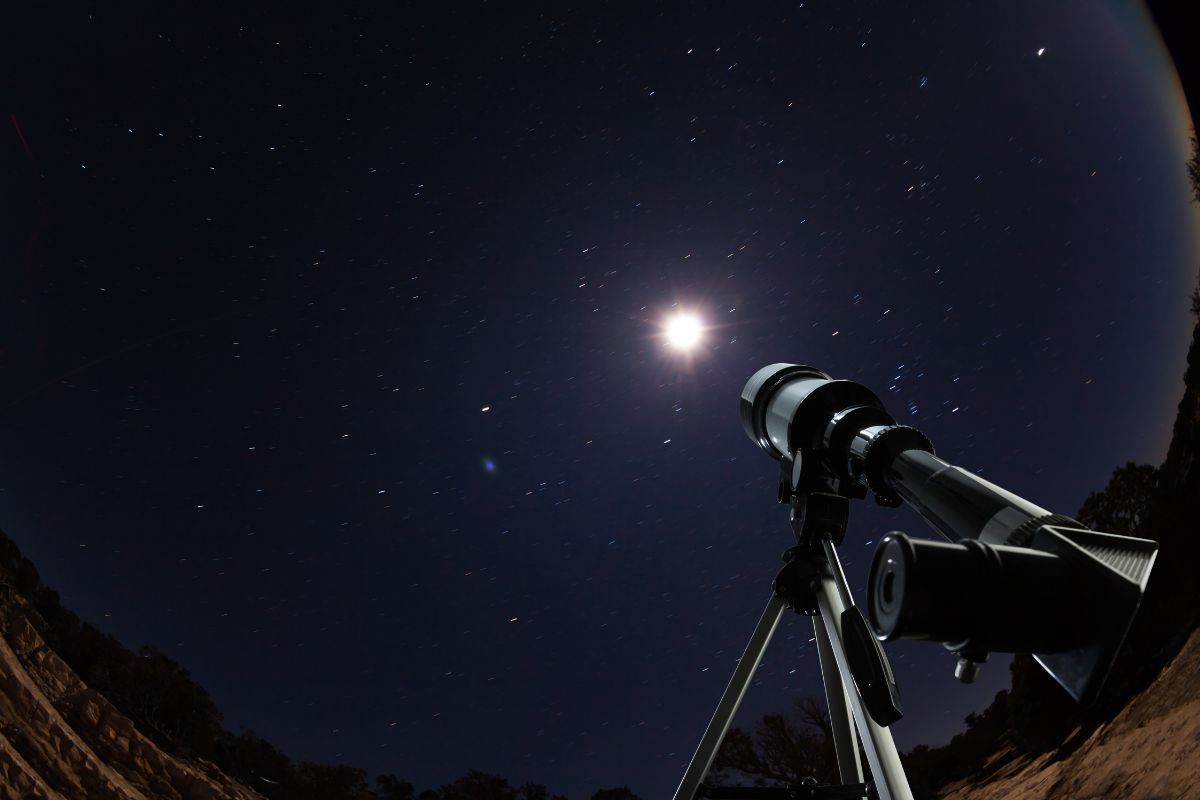
Stargazing in Reunion Island: 6 spots, southern sky, observatory
From the Maïdo to the Plaine des Sables and the Observatoire des Makes: where to observe the southern night sky, which constellations to look for, when to shoot the Milky Way, and how to prepare for a night of stargazing.
Reunion Island, one of the world's most beautiful skies
At 21° south latitude, Reunion Island offers full access to the southern sky, which is hidden from Europe and North America. The Southern Cross, the Magellanic Clouds, and the galactic centre of the Milky Way pass overhead at certain times of year. Combined with the altitude of the Hauts (Maïdo and Plaine des Sables sit above 2,000 m), near-zero light pollution away from the coast, and a tropical climate that's generally clear during austral winter, the island offers one of the most beautiful skies anywhere in France.
This page covers six observation spots (with their Bortle sky-quality rating), the southern constellations season by season, the six main meteor showers, the Observatoire des Makes and its guided evenings, and all the practical tips for preparing a night of stargazing.
The Bortle scale measures sky quality on 9 levels: Bortle 1 = exceptional sky (the Milky Way casts a shadow, thousands of stars visible), Bortle 9 = saturated urban sky (barely a few stars). For comparison, most of mainland France sits at Bortle 4-7 outside very remote areas. Maïdo and Plaine des Sables reach Bortle 1, which is extremely rare in France.
Where to observe the sky in Reunion Island
Six spots ranked from the most accessible (the Observatoire des Makes by car, guided evening) to the most demanding (the summit of Piton des Neiges on a self-sufficient overnight hike).
| # | Spot | Altitude | Sky quality | Access | Note |
|---|---|---|---|---|---|
| 01 | Maïdo | 2,200 m | Bortle 1 (excellent) | Car, parking at the summit | A viewpoint over Mafate on the west side. Expect wind, bring a fleece and windbreaker. Busy during tourist season. |
| 02 | Plaine des Sables | 2,250 m | Bortle 1 (excellent) | Car to the car park, then a short approach walk | A spectacular mineral desert. Wild camping allowed. A clear 360° horizon. Ideal for astrophotography. |
| 03 | Piton de l'Eau | 1,800 m | Bortle 2 (very good) | 2-3 hour hiking trail | A forest plateau accessible on foot only. Wild camping tolerated. Guaranteed peace and quiet. |
| 04 | Piton des Neiges summit | 3,070 m | Bortle 1 (exceptional) | 4-5 hour night hike | The ultimate experience, but reserved for seasoned hikers. A memorable sunrise. |
| 05 | Observatoire des Makes | 1,000 m | Bortle 3 (good) | Car, on a regular road | Guided telescope observation evenings. Family-friendly, with passionate guides. |
| 06 | Bébour-Bélouve forest | 1,500 m | Bortle 2 (very good) | Forest road plus trails | A forest plateau above Salazie. Wild camping allowed. Clear skies outside of fog. |
Four of the six spots can be reached by car (see the Access column above), but you'll be driving up and back down in the dark, so do the route once in daylight first. Once your travel dates are fixed, see which rental cars are available for these night outings.
Constellations and notable objects by season
The sky changes with the seasons. Four highlights throughout the year, each with its own characteristic constellations and objects to point binoculars or a telescope at.
| Season | Main constellations | Objects to look for |
|---|---|---|
| Austral summer (Dec-Feb) | Orion (upside down), Canis Major (Sirius, the brightest star in the sky), Auriga, Taurus (the Pleiades) | Pleiades M45, the Great Orion Nebula M42 (visible with binoculars) |
| Austral autumn (Mar-May) | Leo, Virgo, Centaurus (with Alpha Centauri, the closest star to the Sun), the Southern Cross | The Sombrero Galaxy M104 (telescope), the Omega Centauri globular cluster (binoculars) |
| Austral winter (Jun-Aug) | Scorpius (overhead), Sagittarius (the centre of the Milky Way), a spectacular Milky Way | The galactic centre, the Lagoon Nebula M8 and the Trifid Nebula M20, the M22 cluster (binoculars) |
| Austral spring (Sep-Nov) | Capricornus, Aquarius, the Small and Large Magellanic Clouds (satellite galaxies of the Milky Way) | The Small and Large Magellanic Clouds (visible to the naked eye, southern hemisphere only) |
Six showers to watch throughout the year
The Geminids in December and the Eta Aquariids in May are the most spectacular from the southern hemisphere. Lie down and pick a moonless night to get the most out of it.
| Shower | Peak | Intensity | Notes |
|---|---|---|---|
| Quadrantids | 3-4 January | ≈100 meteors/h at peak | Short activity window (6 h), best watched on the night of 3-4 January |
| Lyrids | 21-22 April | ≈18 meteors/h | A modest shower but with bright meteors. Best after midnight. |
| Eta Aquariids | 5-6 May | ≈50 meteors/h (southern hemisphere) | Excellent from the southern hemisphere. Linked to Halley's Comet. |
| Perseids | 12-13 August | ≈100 meteors/h (moderate in the south) | The best-known shower, better seen from the northern hemisphere. Visible in the south, though less intense. |
| Orionids | 21-22 October | ≈20 meteors/h | Fast meteors, visible all night. Also linked to Halley's Comet. |
| Geminids | 13-14 December | ≈120 meteors/h | The densest shower of the year. Excellent visibility in the south, viewable from 9pm. |
The Observatoire des Makes: telescope evenings
Tucked away in the Hauts of Saint-Louis at 1,000 m altitude, the Observatoire des Makes is a long-standing amateur astronomy site in Reunion Island. Public observation evenings are held there with professional telescopes (up to 600 mm in diameter depending on the evening).
A typical programme:a presentation of the evening sky (star chart, visible constellations, associated mythology), guided observation of the Moon (craters, seas, the terminator line where shadow creates dramatic relief), visible planets depending on the season (Saturn's rings, Jupiter's bands and its Galilean moons, Mars's polar cap), and deep-sky objects (galaxies, nebulae, globular clusters).
Audience:all levels, with children welcome from age 7-8. Passionate, knowledgeable guides. Evenings run in French (worth knowing if you don't speak it), last 2-3 hours and are reasonably priced. Booking recommended. See their official website for time slots, prices, weather-cancellation terms and any astrophotography taster courses.
The most common questions
What's the best place to go stargazing in Reunion Island?
Which constellations can you see from Reunion Island?
When is the best time to go stargazing in Reunion Island?
Do you need a telescope to observe the sky in Reunion Island?
Can you do astrophotography in Reunion Island?
What can you see at the Observatoire des Makes?
Which meteor showers can you see from Reunion Island?
How do you prepare for a night of stargazing in Reunion Island?
Are there astronomy courses or workshops in Reunion Island?
Keep reading
- → Travel photography in Reunion Island: the complete guide, astrophotography included.
- → The Piton de la Fournaise eruption: a night-time spectacle when the volcano is active.
- → All the latest articles in Reunion Island.